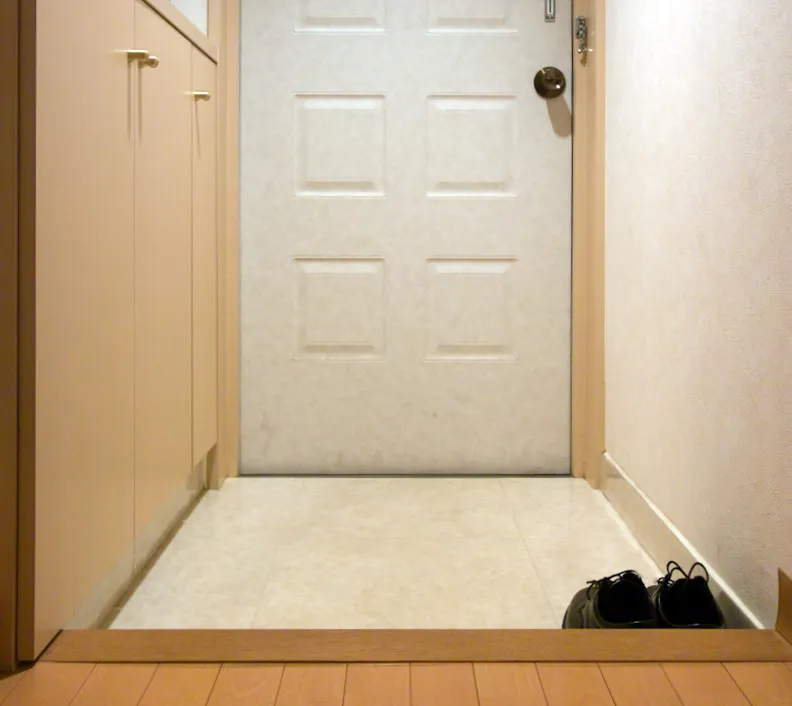
Say It Out Loud: The Two-Second Doorway Habit That Changes How a Household Feels
Photo: Dorothea Lange, Public domain, via Wikimedia Commons
Nobody in my house remembers when we stopped talking in the morning. It wasn't a decision. It just... happened. One day it's "have a good one" over scrambled eggs, and a few months later it's two adults and a teenager passing each other like ships in fog, each glued to a phone, each assuming the other one knows they exist.
Then I read about a habit so small I almost laughed: in Japan, people announce their departures and arrivals. Out loud. Every time.
Itte kimasu: The Phrase That Marks the Threshold
When someone leaves a Japanese home in the morning, they say "itte kimasu" — roughly, "I'm going, and I'll come back." The person staying behind answers "itterasshai" — "go and come back safely." When they return, they call out "tadaima" ("I'm home"), and the household answers "okaeri" ("welcome back").
Neighbors get a version of this too. A morning "ohayō gozaimasu" to the person watering their garden isn't small talk — it's a acknowledgment that you share a street, a morning, a life.
What struck me wasn't the politeness. It was the marking. Departures and returns get a verbal timestamp. The day officially starts, and it officially has people in it.
What We Do Instead
American households have our own rituals, sort of. The garage door groaning open at 6:40. The text sent from the driveway. The grunt that could mean "good morning" or "there's a spider."
Here's the thing about the silent version: it saves maybe four seconds per exchange. But it also tells your brain — and your family's brains — that coming and going is a logistics event, not a relationship event.
There's actual research behind why this matters. Brief, warm acknowledgments between family members are one of the strongest predictors of what relationship researchers call "emotional bids" — tiny moments of connection that, when acknowledged, build trust over time. John Gottman's work found that partners who consistently turn toward each other's small bids stay connected; the ones who brush past them drift. The same logic applies to a kid yelling "I'm home" to an empty hallway.
The One-Week Doorway Experiment
So my family ran a trial. Seven days, one rule, zero cost:
When anyone leaves the house, they say they're leaving. When anyone returns, they say they're home. Whoever's present answers.
That's it. No phones-down requirement, no family meeting, no app. Here's how it shook out.
Day 1–2: It felt ridiculous
My husband announced "I'm leaving now!" to the kitchen like a man reading a legal notice. Our sixteen-year-old treated "I'm home" like a hostage statement. Fine. Ridiculous is the entry fee for most habits worth having.
Day 3–4: The answers started mattering more than the announcements
Somewhere around day three, I noticed the real magic wasn't in saying "I'm out!" — it was in hearing "have a good one, text me when you're there" come back. The exchange takes eight seconds, but it's eight seconds where someone confirms: I noticed you. Your leaving registers.
Day 5–7: The mood shift nobody predicted
By the end of the week, my kid was calling out "tadaima" from the mudroom — half joking, fully committed. And here's the part I didn't expect: the ritual caught the bad moods. You can't bark "I'm home" in the same tone you'd slam a door. The phrase itself smooths the edges. There's a reason Japanese schools and workplaces drill these greetings; they're a circuit breaker for whatever you carried in with you.
Why This Counts as a Remedy
We usually think of natural remedies as things you swallow or soak in. But loneliness and household friction are chronic conditions too, and the cheapest intervention I've found is two seconds at the door.
Think about what the ritual actually does:
- It creates a predictable touchpoint. Even chaotic households get at least two guaranteed moments of contact per person, per day.
- It externalizes transitions. Saying "I'm leaving" helps your own brain close one chapter before opening the next — a mini version of the bedtime reset many of us already practice.
- It costs nothing and scales to any family shape. Roommates, empty nesters, a parent and a dog (the dog counts).
How to Start Tomorrow
Pick your phrases. You can go full Japanese — itte kimasu / itterasshai / tadaima / okaeri — which honestly makes it more fun and more memorable. Or keep it English: "I'm out — see you tonight." "Hey, welcome back."
Two rules make it stick:
- Whoever hears it must answer. An unanswered greeting dies fast. An answered one becomes a habit within a week.
- No make-up sessions. If you forget, let it go. The ritual works because it's light, not because it's enforced.
A week in, our house isn't transformed. But the fog between us lifted a little. Turns out the remedy wasn't a conversation — it was just a door, and two people willing to notice it opening.