Leave It at the Door: The One-Room Japanese Habit That Cleans Up Your Whole House
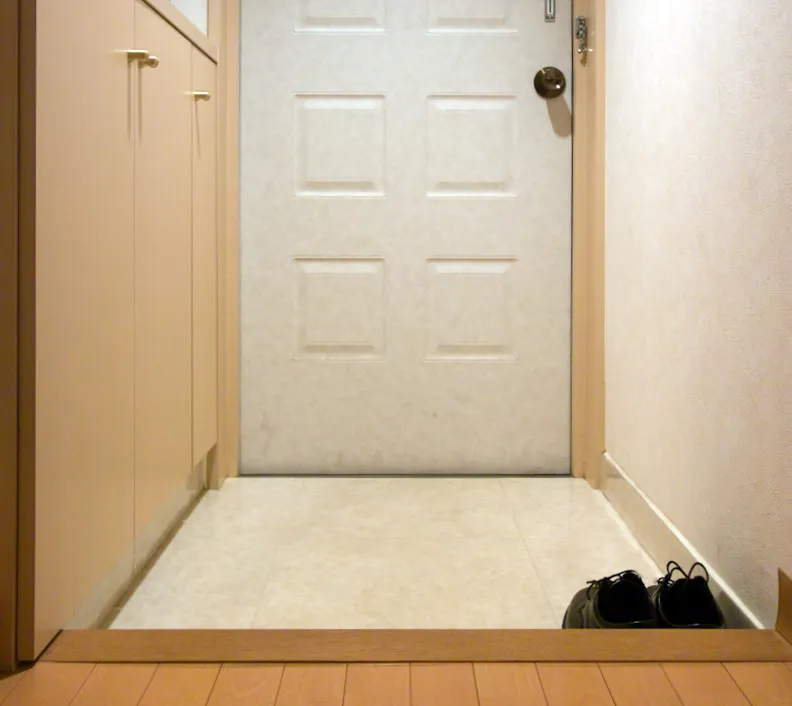
Photo: Fg2, Public domain, via Wikimedia Commons
Ask anyone who's visited a home in Japan about the moment they remember most, and odds are good it's not the food or the futon. It's the pause at the door — the small step up, the shoes turned to face outward, the socks-only shuffle into a house that suddenly feels different.
That entryway, called a genkan, is more than a design quirk. It's a health habit hiding in plain sight, and it might be the single cheapest thing you do for your home this year.
What's Actually on Your Shoes
We tend to think of floors as clean because we clean them. But the research on what footwear tracks indoors is genuinely unpleasant reading.
Studies of residential dust have found pesticides from treated lawns, lead-contaminated soil (a real concern in older American neighborhoods and near busy roads), and a whole zoo of bacteria — including fecal coliforms — hitching a ride on shoe treads. One oft-cited University of Arizona study found that shoes carried an average of over 400,000 bacteria per sole, and that many of those microbes survived for days on flooring.
Shoeless households don't eliminate dust, but they cut one of its main supply lines. Less tracked-in grime means less of it ends up in carpet fibers, on rugs where toddlers play, and — let's be honest — on the floor your baby keeps mouthing everything near.
The Boundary Effect Nobody Talks About
There's a second benefit that doesn't show up in a lab report. The genkan creates what you might call a psychological airlock.
In Japan, crossing that threshold in socks means you've left the outside world — the commute, the coworkers, the parking garage — at the door. Wellness researchers sometimes call this a transition ritual, and it works even if your commute is a walk from the couch to your home office. Your brain loves a clear marker that says: work is over, home has begun.
If you've been struggling to 'turn off' at the end of the day, this is a two-second ritual that costs nothing and signals the shift better than any meditation app notification.
Bonus You Didn't Ask For: Stronger Feet
Here's the part we love at KureKinn, because it fits squarely in the natural remedies tradition: living shoeless indoors is a workout.
Cushioned sneakers are great for pavement and terrible for eight hours of evening floor time. Walking barefoot on real flooring engages the small muscles of the arch, improves balance and proprioception, and encourages the natural splay of the toes that narrow footwear squeezes out. Over weeks, many people notice steadier footing — a quiet but meaningful thing as we age.
Start gradually if you're a lifelong shoe person. Sore arches mean you ramped up too fast, not that barefoot living is wrong for you.
No Mudroom? No Problem
American homes rarely come with a proper genkan, and American winters rarely cooperate. Here's how to build the habit anyway:
Define the zone. A doormat inside plus a pair of house slippers by the door is enough. The mat is where shoes come off; the slippers are where home begins. That physical step-over does the same work as Japan's raised entryway.
Give guests an out. Keep a pair of clean guest slippers or thick socks by the door. Nobody wants to ask a visitor to remove shoes without offering something — it turns an awkward request into a small act of hospitality.
Upgrade the doormat. Two mats, one outside and one inside, catch dramatically more grit than one. Wash them monthly.
Make it easy on yourself. If shoes come off at the door, they need a home: a basket, a rack, a corner. Friction kills habits, and a shoe pile in the living room kills this one fast.
Loosen the rules when it matters less. Some households go strict; others do shoes-off from spring through fall and relax in January. A loose rule you follow beats a strict one you abandon.
Small Ritual, Real Returns
The genkan won't replace vacuuming, and it won't fix a dusty HVAC filter. But as health habits go, it's remarkable: no supplement, no gadget, no subscription. Just a line at the door — one side carrying the street, the other holding your evening.
Try it for two weeks. Your floors, your feet, and your post-work brain may all quietly thank you.