Warm Hands Before Coffee: The Japanese Morning Soup Habit You Can Build in 4 Minutes
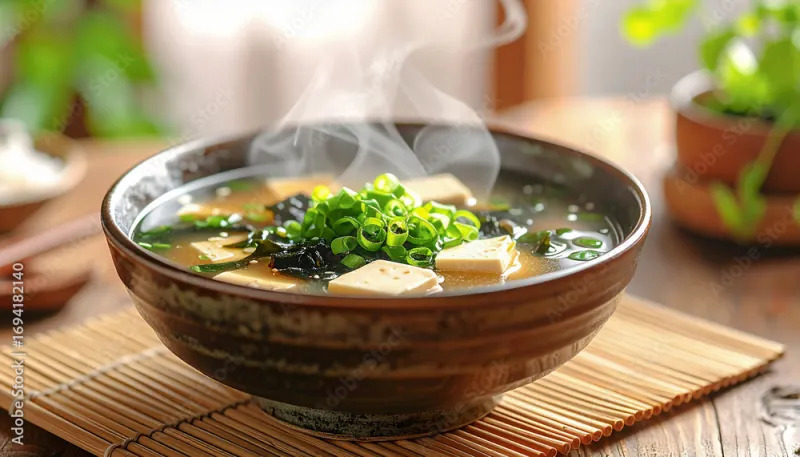
Photo: steaming bowl of miso soup on kitchen counter morning light, via as2.ftcdn.net
There's a moment in nearly every Japanese household around 7 a.m.: the sound of a kettle clicking on, the tear of a little foil packet, and within minutes, steam rising off a bowl of miso soup. Nobody films it. Nobody calls it a ritual. It's just breakfast — the way a lot of Americans treat a granola bar eaten over the steering wheel.
But there's something worth borrowing here, and it's not the soup itself. It's the principle: start the day with something warm, savory, and easy enough that you'll actually do it every single morning.
Why Warm Wins Before 9 A.M.
Ask any Japanese grandmother why miso soup belongs at breakfast and she'll probably shrug. But there's real logic underneath the tradition.
Warm liquids first thing may help gently wake up digestion — your gut tends to be at its sleepiest in the early morning, and a warm bowl is a softer handshake than a cold smoothie chugged at highway speed. There's also the hydration factor: after seven or eight hours of sleep, you're mildly dehydrated, and soup is one of the most pleasant ways to rehydrate before caffeine.
And then there's the savory angle. Most American breakfasts lean sweet — cereal, pastries, flavored yogurt, that $8 smoothie. Sweet breakfasts spike and crash. A savory, umami-rich bowl tends to satisfy differently. Umami is the taste of satisfaction, and starting with it can blunt the mid-morning snack hunt before it starts.
None of this requires you to believe in anything mystical. It's just: warm, salty, savory, quick.
The American Kitchen Already Has Everything You Need
Here's where the vending-machine fantasy falls apart in a good way. Japan's convenience-store soup culture exists because it's easy. Your version can be just as easy.
Your shopping list:
- Instant dashi or miso paste packets. Dashi — the kelp-and-bonito broth base — comes in single-serve sachets at most grocery stores now, tucked near the soy sauce. Miso paste in a tub works too; it lives in the fridge for months.
- Frozen vegetables. Spinach, edamame, diced carrots, green beans, corn. Frozen is not a compromise here — it's picked at peak ripeness and it's already cut.
- Soft protein. A handful of cubed tofu, a beaten egg stirred into hot broth, leftover shredded chicken from last night's dinner.
- A microwave and a kettle or hot tap. That's the whole setup.
The technique takes four minutes, and the first minute is the kettle doing the work:
- Drop frozen veggies and protein into a big mug or deep bowl.
- Cover with water and microwave 2–3 minutes until steaming.
- Stir in dashi powder or a spoonful of miso (never boil miso — it kills the flavor) off the heat.
- Drink it standing at the counter like a person who has places to be.
Total active effort: about 60 seconds. Cost per bowl: somewhere between 40 and 80 cents. Compare that to the drive-thru latte-and-muffin routine and the math stops being funny.
A Five-Day Rotation So You Never Decide Anything
The habit dies when it requires thought at 6:45 a.m. So don't think. Rotate:
- Monday — Classic miso-spinach-tofu. The gateway bowl. Miso paste, frozen spinach, cubed tofu.
- Tuesday — Egg drop dashi. Whisk an egg, drizzle it slowly into hot dashi while stirring. Scallion if you're fancy.
- Wednesday — Corn and butter miso. A pat of butter and frozen corn in miso broth tastes like a concession-stand cup of soup with a college degree.
- Thursday — Chicken and carrot dashi. Last night's rotisserie chicken scraps, frozen diced carrots, instant dashi. Basically free.
- Friday — Miso with edamame and rice. Dump in leftover rice along with the edamame and you've accidentally made a full breakfast.
Notice what's missing: measuring, recipes, cleanup beyond one mug. That's the point. The Japanese daily soup habit survived because it fit inside the morning, not on top of it.
The Part Nobody Puts on a Label
There's also something less measurable happening when you start the day with a warm bowl. You sit down — or at least stand still — for four minutes. You taste something instead of inhaling something. In a country where breakfast is the meal most likely to be eaten horizontally, that pause is the actual wellness product.
Japan didn't invent soup. It just refused to make breakfast complicated, and kept the warm thing coming every day for centuries. You have a microwave, a freezer full of vegetables, and four minutes. That's the whole machine.
Start Monday. By Friday, the kettle click will feel as automatic as the coffee maker — and the 3 p.m. snack drawer might notice the difference before you do.