Ten Square Feet of Truth: Your Entryway Is Keeping Score of Your Stress
There's a diagnostic trick I learned from a Japanese friend that costs nothing and takes about ninety seconds: walk into your house the way you actually walk into your house — tired, distracted, maybe carrying groceries — and stop. Don't clean anything. Just look.
What you're looking at, she told me, is not a mess. It's a mood reading.
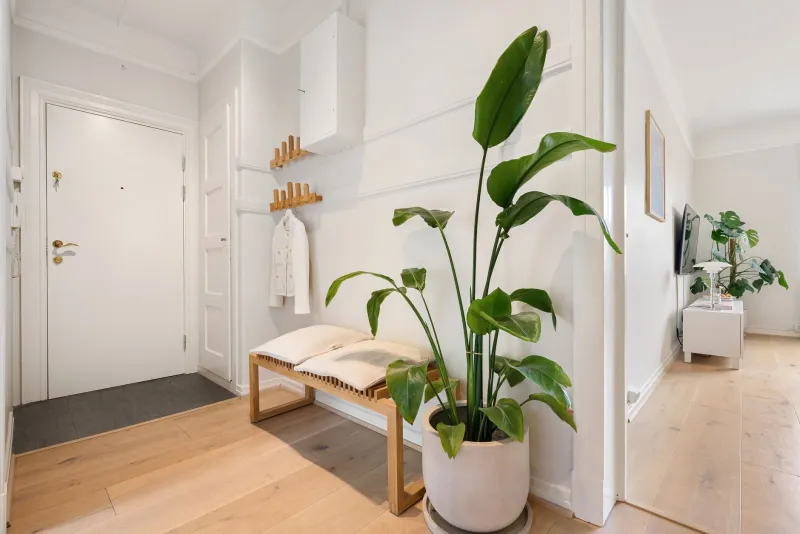
In Japan, this space is called the genkan, and it's treated with a seriousness that can seem strange to American eyes. It's a slightly lowered area right inside the front door where shoes come off, coats get sorted, and the outside world is, quite literally, stepped out of. The genkan isn't decoration. It's a hinge — the one place in the home where you transition from out there to in here.
And here's the thing: most of us are blowing that transition every single day. We carry the commute, the inbox, the parking garage rage straight through the front door and dump it on the living room couch. The clutter in your entryway isn't just clutter. It's the physical residue of a transition that never happened.
The Five-Point Entryway Audit
Grab a mental notepad and score yourself, honestly, on each of these. Zero means "not an issue," five means "cry for help."
1. The shoe situation. Are shoes lined up neatly, or is there a pile that suggests people were fleeing a fire? In a Japanese home, shoes point toward the door so they're easy to slip back into. That tiny act of ordering is also a tiny act of closing — the day ends at the threshold. A shoe avalanche usually means nobody in the house believes they're really done with the day.
2. The mail monument. That stack on the console table or the floor? It's not paper, it's cortisol in envelope form. Every unopened utility bill is a small open loop your brain keeps re-checking. Japanese homes tend to handle mail at the genkan or not at all — recycling goes out the same day the mail comes in.
3. The coat situation. Coats crammed on hooks, draped over banisters, or migrating onto the treadmill all signal the same thing: this house has no clear off-ramp. You need one hook per person, max, and the rule is one coat out, everything else to the closet.
4. Lighting. Stand in your entryway at dusk. Is it a warm pool of light, or the fluorescent afterthought of a builder-grade fixture? Harsh overhead light at the threshold tells your nervous system keep driving. Warm, low light says arrive.
5. The pause spot. This is the big one. Is there anywhere in that ten square feet — a bench, a step, even the edge of a stair — where a person could physically stop for ten seconds? If not, your entryway is a hallway, not a threshold. You're moving through it at highway speed, which means the workday is too.
Add it up. Anything over twelve and your entryway is officially working against you.
The $0 Makeover
You don't need a mudroom renovation or a trip to The Container Store. The Japanese approach is famously spare, and the fixes below cost nothing but fifteen minutes and a little decisiveness.
Empty the zone completely. Pull everything out of the entryway that doesn't live there. You'll be surprised how much is just homeless objects squatting near the door.
Point the shoes. Line up whatever shoes are actually in rotation and turn them to face the door. It sounds fussy. It takes eight seconds and it makes the whole space read as kept instead of given up on.
Kill the mail pile at the source. Put a small recycling bin — a paper grocery bag works — wherever mail first lands, and shred or toss junk the moment it enters. The pile can't build if there's no place for it to sit.
Ration the hooks. One per person. When a hook is full, the next coat goes to the closet. This single rule ends about 80% of entryway chaos.
Swap the bulb or the shade. If you have a spare warm bulb in a drawer somewhere, this is its moment. If not, even a lamp relocated from another room softens the arrival.
Invent a pause spot. A bench, an ottoman, a stair. The ritual is simple: sit, take a breath, notice you're home. In Japan this pause is built into the architecture — the step down into the genkan forces a beat. You can fake it with any flat surface.
Why This Counts as a Remedy
I know what you're thinking: this is a wellness site, and I'm telling you to organize your shoes. But stress doesn't respond only to supplements and meditation apps. It responds to cues — and the most powerful cue you experience every day is the moment you cross your own threshold.
Researchers who study transitions between work and home consistently find that a deliberate buffer — even a short one — lowers how much job stress leaks into family time. The Japanese didn't need a study for this. They built the buffer into the floor plan a few centuries ago.
So tonight, when you walk in, don't blow past the pile. Stop at the door. Look at it like a thermometer. Then spend fifteen minutes resetting it — and notice how the rest of the house, and the person walking through it, feels a little lighter by the time the shoes come off.