Put the Fork Down at 80%: What Okinawa's Oldest Eaters Know About Portion Control
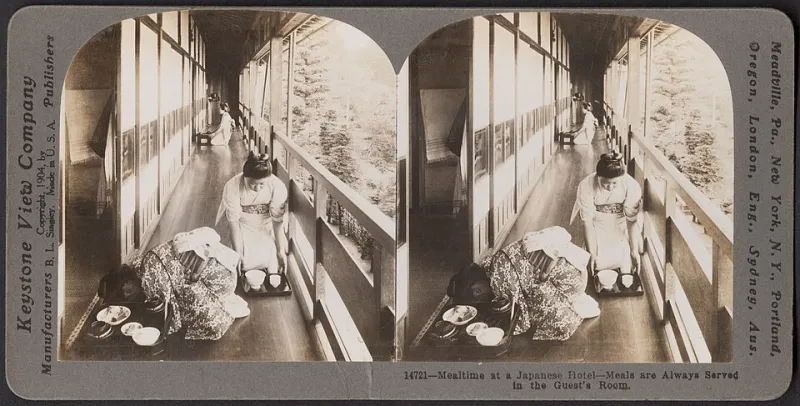
Photo: Singley, B. L. (Benjamin Lloyd); Keystone View Company, Public domain, via Wikimedia Commons
There's a phrase Okinawan elders say before meals: hara hachi bu — eat until your stomach is eight parts out of ten full. Not a diet. Not a cleanse. Just a built-in brake, repeated like a grace note before every meal.
Compare that with the American approach to eating, which tends to swing between two extremes: unrestricted abundance and punishing restriction. Whole30 in January, delivery apps by March. What's missing, some experts argue, is a middle path — and Okinawa, one of the world's famous Blue Zones, may have been living on it for generations.
Why 'Almost Full' Beats 'Totally Full'
Here's the uncomfortable biology: your brain registers fullness on a delay. Signals of satiety — stretch receptors in the stomach, hormones like leptin and GLP-1 — take roughly 15 to 20 minutes to reach full volume. If you eat until you feel full, you've likely already overshot by hundreds of calories.
"Hara hachi bu essentially builds a buffer for that delay," explains one registered dietitian we spoke with, who uses the practice with clients who describe themselves as chronic overeaters. "You stop before the signals finish arriving. It's not willpower — it's timing."
The Okinawan Centenarian Study, which documented remarkable longevity and low rates of obesity on the island, credited caloric moderation as one contributing factor among many. And broader research on portion psychology backs the mechanism: studies from Cornell's food and brand lab have shown people consistently underestimate how much they eat, and that smaller default portions reduce intake without increasing perceived hunger.
The Antidote to All-or-Nothing Dieting
What makes hara hachi bu different from every diet you've quit?
It has no forbidden foods. Nothing is off the menu. The only rule is the stopping point.
It's not about numbers. No counting, no macros, no weighing chicken breasts on a food scale at 7 a.m.
It's a habit, not a phase. Diets end. This is designed to be boring — a quiet, repeatable practice at every meal for life.
Dietitians we interviewed noted that clients who adopt a single, sustainable eating behavior tend to see better long-term results than those attempting sweeping overhauls. "The best diet is the one you forget you're doing," one put it.
How to Actually Feel 80% Full
The tricky part: how do you know when you're there? Most people describe it as the moment hunger fades and before the heavy, stuffed sensation begins. Think: satisfied, not sedated.
A few habits that make the signal easier to catch:
- Slow the first five bites. Deliberately chewing early in the meal gives satiety hormones a head start.
- Use smaller plates. Japanese meal culture traditionally uses smaller dishes, which makes a modest portion look generous.
- Pause halfway. Put the fork down for two minutes at the meal's midpoint. It's the single most effective trick our sources recommended.
- Eat without a screen. Distracted eating reliably increases intake. That's not wellness folklore; it's one of the most replicated findings in eating-behavior research.
Your 30-Day Hara Hachi Bu Plan
No calorie counting. No food rules. Just four weeks of gentle practice:
Week 1 — Observe. Don't change anything yet. Just notice, at the end of each meal, how full you actually feel on a 1–10 scale. Most people are surprised by how often they land at 9 or 10.
Week 2 — Pause. Add the mid-meal fork-down pause to one meal a day. Notice what you want to do when you resume. Often you'll eat noticeably less without feeling deprived.
Week 3 — Practice. Aim to stop at 8 out of 10 at one meal daily. Expect to misjudge it. That's fine — this is calibration, not a test.
Week 4 — Make it yours. Extend the practice to two meals a day, or wherever it fits naturally. By now, the pause should feel automatic rather than effortful.
What It Won't Do
Honesty matters: no eating practice is a guarantee of weight loss, and individual results vary widely. Hara hachi bu isn't a treatment for eating disorders, and anyone with a history of disordered eating should talk with a professional before adopting any restriction-adjacent habit. What it offers is something rarer — a way to eat less without the mental tax of dieting.
The Okinawans who practice it aren't chasing a number on a scale. They're just leaving a little room at the table. In a culture that treats every meal as either a cheat day or a punishment, that small act of moderation might be the most radical wellness tool of all.